Introduction
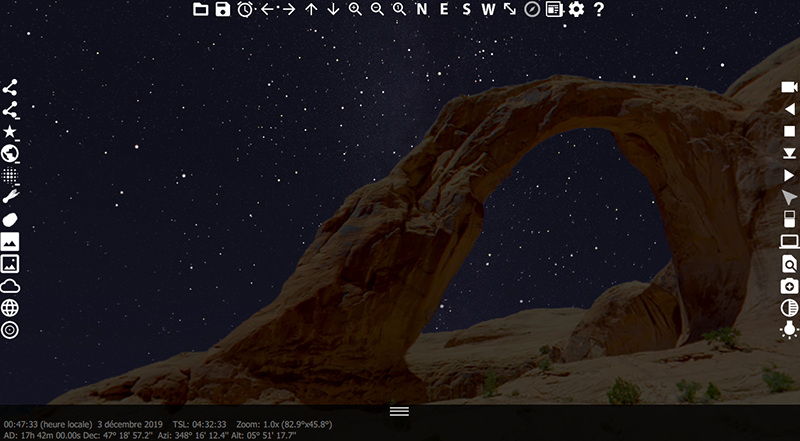
WinStars 3 is a planetarium for almost any platform. Employing 3D technology to display our solar system in a realistic manner, users may tour the planets, follow a space probe on its long voyage, or observe a celestial event from a distant world, as well as receiving the latest astrophysical news from a live feed. Updates add new features and functionality, transforming it into an advanced educational tool for discovering our Universe.
Features
Gaia DR2 catalogue with more than 1.7 billion stars (internet connection needed).
More than 30,000 galaxies, nebulae, star clusters (OpenNGC + EDD Catalogues).
A direction of observation which is easily controlled by a mouse and in real time.
A precise representation of the observable sky from a point on the Earth’s surface on a given date.
A 3D interface to give more realism to celestial objects.
Virtual textures to display high resolution surface details of planets.
Travel throughout the solar system, to over 200,000 stars, the edge of our galaxy and beyond.
Follows the latest scientific news by downloading additional modules.
A calculation of notable astronomical phenomena visible from an observation point on the earth.
Detailed information about each object.
A calculation of positions of the principal satellites of Mars, Jupiter, Saturn, Uranus and Neptune, of comets and of asteroids.
An outline of the celestial equator, the ecliptic, and a grid of azimuthal and equatorial coordinates.
A 3D outline of the planetary orbits.
Сontrol a large range of telescopes.
Internet resources are also available: updated comets and asteroids’ elements, querying of DSS (Digitized Sky Survey) servers to obtain a photograph of that portion of the sky being displayed by the program, a notice of the visibility of artificial satellites, etc.
Automatic updates.
Available languages: english, french, german, spanish, russian