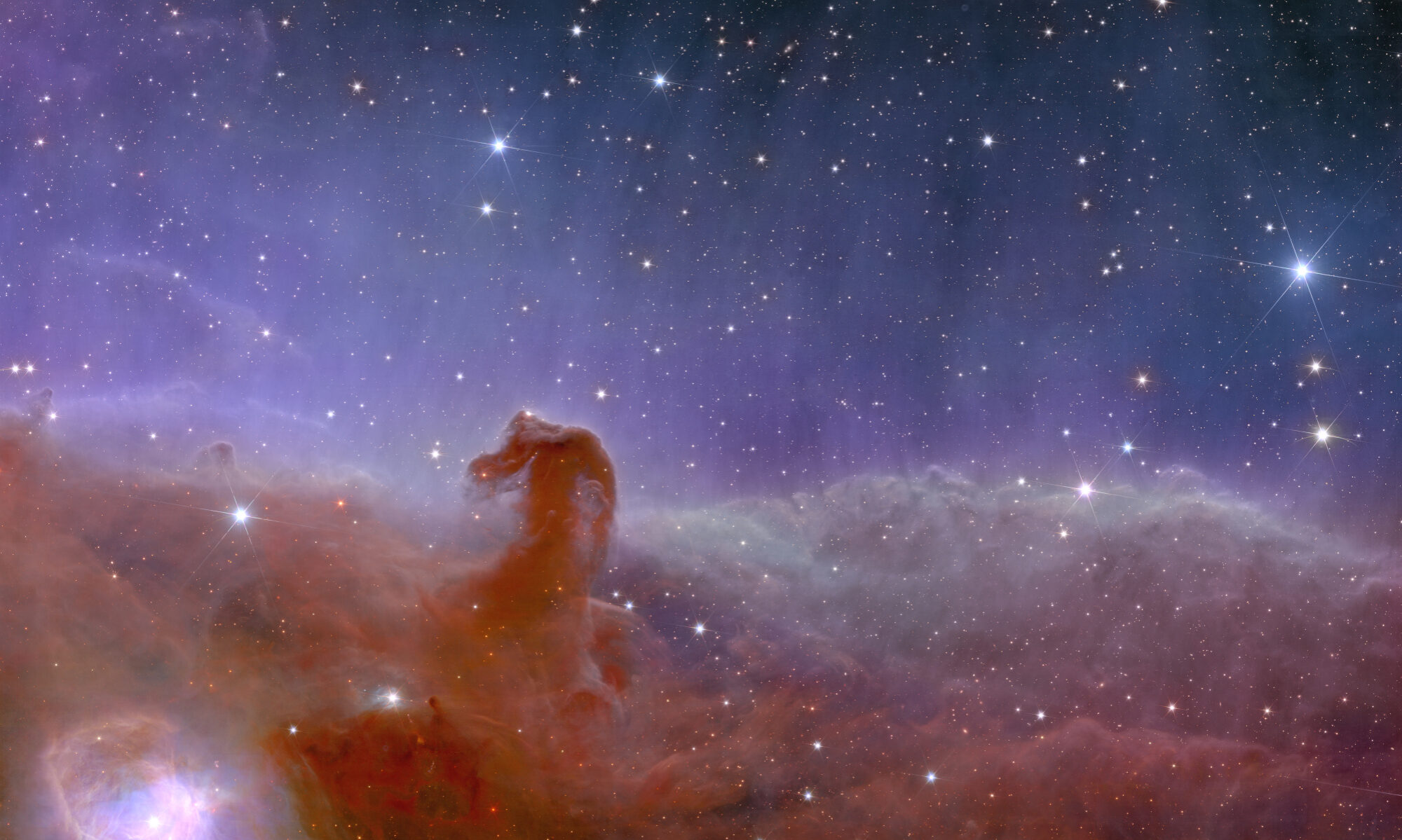


Version 3.0.316 is available starting today. I will gloss over the revisions from the past two weeks: 3.0.313 gathered precision fixes, while 3.0.314 and 3.0.315, released on the same day, simply brought the same build back on track on Android and Linux. Two things truly deserve a closer look: astronomical accuracy measurements and the overhaul of the surfaces of Earth, the Moon, and Mars.
3.0.316: Earth, the Moon, and Mars
Planetary surface rendering has been reworked from the ground up. The textures for Earth, the Moon, and Mars have been rebuilt from original public datasets: NASA’s Blue Marble Next Generation for Earth’s colors, the GEBCO 2026 bathymetric model for its ocean floors, Lunar Reconnaissance Orbiter (LRO) mosaics – LOLA for elevation, WAC as an alternate- and the HRSC -MOLA blend published by the USGS for Mars. Everything has been produced in four levels of detail, keeping elevation separate from color. Two effects are immediately visible, and a third is felt in use: seams between tiles have disappeared; a crater or mountain range is no longer a mere flat light-colored patch, as terrain now casts its own shadows; and finally, mesh preparation overhead has been reduced by roughly 40%, with no visible loss, benefiting lower-end hardware.
On a planet, touch panning no longer depends on gesture speed, but on the actual visible terrain: the point beneath your finger stays locked to the ground at an altitude of a hundred kilometers just as at three thousand, and a horizontal swipe no longer scrolls the surface faster than a vertical one. Earth’s clouds also gain altitude and cast their own shadows; the “Cloud shadows” checkbox in the Planets dialog, enabled by default starting with this release, toggles this effect immediately. On Android tablets, however, they remain a flat layer due to the lack of an elevation map. Furthermore, the desktop 3D display panel now lets you select the graphics API version in use: the software queries the hardware and only lists what the GPU actually supports.
Accuracy, Measured
Comet magnitudes now incorporate the k2 activity index from catalogs, which was previously read without ever being applied—accounting for a difference of 0.4 to 1.7 magnitudes depending on the object. Similarly, asteroids ignored the G slope parameter of Bowell’s H,G magnitude system—Ceres appeared 0.64 magnitudes too bright, and Pallas 1.00; the discrepancy is now down to 0.02 and 0.05 magnitudes. The moons of Jupiter, Mars, and Saturn were fed Universal Time instead of the Dynamical Time required by their orbital theories—an offset of roughly sixty seconds, representing anywhere from 367 km for Titan up to 1,218 km for Io. As for the Moon, accuracy is now well under 0.1 arcseconds. This issue only affected Solar System mode.
Everything has been benchmarked against JPL ephemerides. Comets and asteroids show the most noticeable visual difference: predicted magnitudes over the coming weeks will far better match what you actually see through the eyepiece.
Crash Reports
Since version 3.0.312, WinStars detects abnormal terminations and prepares a report upon the next launch, without transmitting anything without explicit consent. This report includes the version, hardware details, the timestamp of the last normally rendered frame, and one hundred and forty lines of log output—with no name, email address, or location data. Two related annoyances were fixed right afterward: closing a window during startup no longer triggers a false crash alert, and sending a report can no longer freeze the application on exit.