Time and date setting
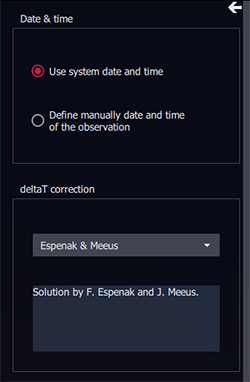
Date & time
By choosing “Use system date and time”, the program uses the computer clock to represent the sky as it appears when the program is used.
The second option allows you to manually define the time and date of the observation.
Correction ΔT
In precise timing, ΔT is a measure of the cumulative difference between the Earth’s rotation period and atomic time. Formally, it is the time shift obtained by subtracting the Universal Time (UT, defined by the Earth’s rotation) from the Earth’s Time (TT, independent of the Earth’s rotation): ΔT = TT - UT. The value of ΔT for the beginning of 1902 is about zero; for 2002, it is about 64 seconds. Thus, between 1902 and 2002, the Earth’s rotations took about 64 seconds longer than the nominal duration.
The menu offers two settings: no time correction, or the polynomial model published in 2006 by F. Espenak and J. Meeus, “Polynomial Expressions for Delta T (ΔT) - Five Millennium Canon of Solar Eclipses”: https://eclipse.gsfc.nasa.gov/SEcat5/deltatpoly.html.
Validity range of the models
The Espenak & Meeus (2006) polynomials cover the period from −1900 to +2200.
The model based on daily values of the length of the day, by Stephenson, Stephenson, Morrison & Hohenkerk (2016, Proceedings of the Royal Society A) covers −1800 to +2200; it is the most recent scientific reference commonly quoted.
The measured values and the official predictions of the Earth orientation system come from the IERS Earth Orientation Service Bulletins A and B.
Why this correction matters
A difference of 1 second in ΔT shifts the computed position by about 15 seconds of right ascension, that is a quarter of an arcminute: negligible when pointing at an object with the naked eye, noticeable when pointing at a tight object in a high-power eyepiece, and decisive when computing an occultation or a transit.
Note
Outside the periods covered by the proposed models, the software extrapolates: the correction shown then has no measured value behind it. If your calculations go well outside the 20th to 21st centuries, compare with the IERS tables, or choose “no correction” while knowing the difference.